
Browse all guides
2 guides in Where to stay

Beijing hostels: ten historical picks and a practical stay guide
Explore ten names from the 2017 Beijing hostel guide and compare neighbourhoods, rooms, bathrooms, arrival arrangements and present-day booking details.
How to choose a Beijing hotel
Compare Beijing hotels by real journeys, room needs, atmosphere, total price, check-in and cancellation terms.
A good place to stay makes Beijing easier to explore. The right choice depends on where you will spend your days, how you like to travel and what you need from the room. Start with a convenient neighbourhood and the actual walk to transport, then compare accommodation types and booking terms. A famous district or a low headline rate alone does not tell you whether a property will suit your trip.
Choose a useful base
Wangfujing and Dongsi are sensible areas to investigate for a first visit focused on central sights. Qianmen can suit a plan built around the southern old city and Temple of Heaven. Around Shichahai, lanes and lakes create a different atmosphere, although access to an individual courtyard property may involve a walk with luggage. Sanlitun and the eastern business districts may be more convenient for meetings, restaurants or nightlife than for repeated trips to the western gardens.
 View & share image
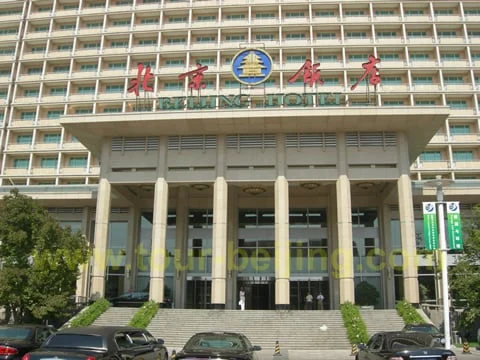
Beijing Hotel beside Wangfujing, pictured in Tour Beijing’s walking guide. Confirm the entrance and current room details when choosing accommodation. Photograph: Tour Beijing.
Haidian deserves consideration for university visits and time in northwestern Beijing. An airport hotel can be useful for an awkward flight connection, but check which airport it serves: Capital Airport and Daxing Airport are different destinations. Use Tour Beijing's area guide to staying in Beijing as a starting map, then check current properties and transport for your own itinerary.
Hotels, courtyard stays and hostels
A full-service hotel may be helpful when you want a staffed reception, assistance with arrivals and predictable facilities. Check the exact room category: a hotel's general description does not guarantee a window, bathtub, twin beds or a particular view in every room. Confirm breakfast arrangements, extra-bed options and whether the quoted rate includes all mandatory charges.
Courtyard accommodation can offer a memorable setting, but ask practical questions about stairs, sound insulation, heating, air-conditioning and bathroom layout. A photogenic courtyard is not a promise of a quiet room. For hostels, distinguish a private room from a dormitory bed, and check bathroom sharing, storage and late-arrival arrangements. If choosing an apartment, confirm the reception and check-in process as well as cooking and laundry facilities.
Check the map at street level
Find the property entrance and the nearest convenient metro entrance. A straight line on a map can conceal a broad road, an inconvenient crossing or a long walk around a closed compound. Ask whether taxis can stop at the door and where a driver should wait. This matters especially with children, heavy luggage or reduced mobility.
Compare the hotel with two or three places you will visit repeatedly, not only one landmark. Look at the transfer count as well as the journey length. If your plans include evening shows, check the return route and noise around the property. Our hotel selection guide gives a more detailed comparison method, while transport explains arrival and station planning.
Book the room you actually need
Ask the property to confirm that it can complete check-in and accommodation registration using your travel documents. Supply the names required for the booking and check which documents each guest must present. A booking platform's acceptance of a reservation should not replace direct clarification when you have an unusual arrival time, document type or room requirement.
For a family, confirm maximum room occupancy, children's breakfast charges, bed configuration and any extra-bed request in writing. For accessibility needs, ask about the full route from entrance to room and bathroom rather than relying on a general accessible label. If avoiding smoke is important, request a non-smoking room and ask how the property handles the designation.
Read the price and cancellation terms
Compare the final stay total for the same room, dates, occupancy and inclusions. A cheaper non-refundable rate is a different product from a flexible booking. Check the cancellation deadline in the property's local time, payment currency, prepayment conditions and any deposit collected on arrival. Keep the confirmation and a way to contact the property outside the booking application.
Do not assume a price quoted in a travel article is available for your dates. Holidays, conferences and room availability can change the comparison. Likewise, verify that a named hotel is still operating before arranging a transfer there. Older lists may include renamed or closed properties; the owner confirms that the former Opposite House site has been redeveloped for retail, so it should not be treated as a current hotel recommendation.
Make arrival straightforward
Save the hotel's Chinese name, address, telephone number and map pin. Send your estimated arrival time and ask what happens if your flight is delayed. Clarify the location and operation of any shuttle; a hotel with an airport name is not necessarily inside the terminal. For a very early arrival, ask whether luggage storage is available and whether access to a room needs a separate arrangement.
Before leaving reception, confirm breakfast, the Wi-Fi instructions and the best address to show a taxi driver. Reconfirm a departure transfer with the correct airport or railway station. A little preparation at these two ends of the stay can be worth more than an additional advertised amenity.
More help with accommodation
Use Beijing hotel selection for a decision checklist and sights and neighbourhoods to understand your daily destinations. Tour Beijing's hotel resources offer another local starting point. Beijing Page is associated with Tour Beijing; check availability, current facilities and the binding booking terms with the property or booking provider you choose.