
Choosing a Beijing hotel is easier when you compare a small shortlist against the same needs. Begin with the journeys you expect to make, the room you need and the booking flexibility you value. This guide is a practical selection exercise; the accommodation hub explains neighbourhoods and types of stay in more detail.
1. Put your trip on the map
Mark your arrival point, departure point and three main activities. A first sightseeing visit might centre on the imperial city and Temple of Heaven; a university trip may repeatedly take you to Haidian; meetings could place you in eastern Beijing. Select a base that reduces the journeys you will make most often. There is no single best hotel district for all of these visits.
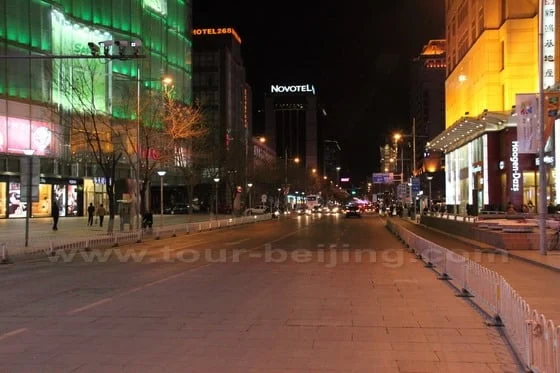
Jinyu Hutong near Wangfujing, pictured at night. Check the exact hotel entrance and the final walk from your station. Photograph: Tour Beijing.
Tour Beijing's where-to-stay map and area descriptions can help orient the search. Treat its individual property and district descriptions as starting ideas, then check today's entrances and services. Avoid choosing a hotel solely because its address contains the name of a large district or a landmark some distance away.
2. Test the actual journeys
For each shortlisted hotel, estimate a morning trip to your main sight, an evening return and your luggage journey on departure day. Consider walking, changes of line, station entrances and road traffic. A slightly longer ride with no transfer may be preferable to several changes when travelling with children or bags.
Check the property's entrance on a street map and ask whether a car can reach it. Courtyard lanes can be attractive places to stay, but the final approach may differ from the pin shown by a booking platform. If you expect to use a taxi, save the Chinese address and the recommended drop-off point. See Beijing transport before assuming a railway station or airport is nearby.
3. Compare the room, not only the hotel
Write down essentials before reading promotional descriptions: one large bed or two separate beds, a window, quiet, a lift, a suitable bathroom, space for luggage and dependable temperature control. Ask about the specific room category you are buying. Photographs of a suite or public lounge may tell you little about an entry-level room.
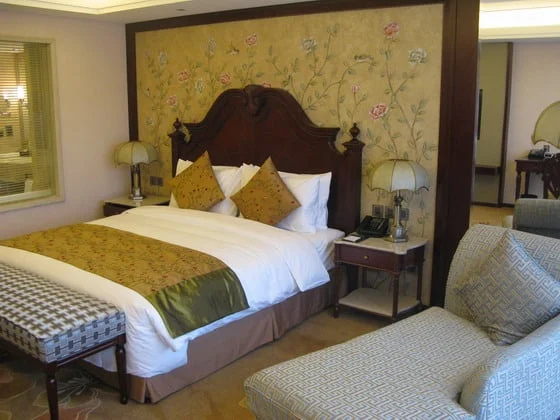
A room pictured in an older Tour Beijing hotel travelogue. Check photographs and facilities for the specific room category you plan to book. Photograph: Tour Beijing.
For two adults and a child, confirm occupancy rules, actual bed sizes, breakfast entitlement and any charge for an extra bed. A room advertised for two guests may not meet a family's needs. For a longer stay, laundry arrangements, storage and a comfortable work surface may matter more than a decorative lobby. Have the property confirm any request on which your decision depends.
4. Weigh atmosphere against convenience
A courtyard stay offers a different experience from a large hotel. Ask about sound between rooms, steps, bathroom privacy and access in bad weather. For a street-facing room in a dining or nightlife district, discuss noise and whether a quieter room can be requested. A central address does not guarantee a restful night.
For an airport stopover, prioritise the correct airport, late reception and a clearly explained transfer. Capital and Daxing are separate airports; a vague promise of an airport shuttle is not enough. For business, check the meeting address rather than treating all of the Central Business District or all of Haidian as one compact place.
5. Make a fair price comparison
Compare the same dates, room type, number of guests and meal plan. Include mandatory taxes or charges shown at checkout, transport costs and any extra bed or breakfast you need. Check whether the payment is charged immediately, taken at the hotel or only used to guarantee the booking. Record the currency so that two apparently similar rates do not mislead you.
A flexible rate may be valuable while flights or attraction reservations remain uncertain. Read the cancellation deadline and the amount forfeited, rather than assuming every cancellable booking can be cancelled on arrival day. For a long stay, ask whether leaving early changes the rate. Save a copy of the terms that applied when you booked.
6. Confirm check-in before committing
Ask the property to confirm document requirements, accommodation registration and arrangements for every guest. Explain a late arrival, early-morning departure or a need for step-free access before making a non-refundable payment. Request a concrete answer about the relevant facility or process instead of accepting a general assurance that everything is convenient.
For accessibility, ask about the pavement approach, entrance steps, lift dimensions where relevant and bathroom layout. For a non-smoking stay, confirm the room designation and discuss alternatives if the room does not meet it. Keep important replies with the booking confirmation so you can resolve a misunderstanding without relying on a memory of a telephone conversation.
A final shortlist check
Before paying, make sure you can answer these questions:
- Where is the entrance, and how will I reach it with luggage?
- Does the room fit every guest and the facilities we actually need?
- What is the total cost, payment schedule and cancellation deadline?
- Can the property complete check-in using our documents?
- How will we reach the correct airport or station on departure day?
Choose the property that answers these questions most convincingly for your visit, rather than the one with the longest amenity list. Then build an enjoyable daily rhythm through sightseeing, food and dining and evening activities. Beijing Page is associated with Tour Beijing; its hotel resources can provide further local orientation, while your confirmed booking governs the actual stay.